



In a classroom in Redding, California, a teacher told students from across America that leaders who commit abuse, sexual abuse, financial abuse, abuse of power, should never face punishment.
Not reduced consequences.
Not delayed accountability.
None. Ever. On theological grounds.
They wrote it down. They took it home. And that teaching is now the invisible framework protecting the most powerful man in America from the consequences of thirty-four felony convictions, two impeachments, a civil judgment for sexual abuse, and an attempt to overturn a democratic election.
The teacher was Danny Silk. The institution was Bethel School of Supernatural Ministry. The book he wrote from that teaching, Unpunishable: Ending Our Love Affair with Punishment, became a Christian bestseller.
And somewhere along the way it stopped being a theology lesson.
It became a shield.
Nobody in that classroom asked the question that mattered.
What happens when a predator finds a framework that has abolished accountability entirely?
You are living in the answer.
That question has an answer now.
It has an answer in the wreckage of a ministry school where a diagnosed sociopath groomed women across three continents for a decade while the men responsible for stopping him kept finding theological reasons not to.
It has an answer in the January 6 footage where men and women carrying wooden crosses and wearing Jesus Saves shirts forced their way into the United States Capitol because their pastor told them the anointed king was being stolen from them by demonic forces.
It has an answer in every felony conviction, every civil judgment, every credible accusation that rolled off Donald Trump like water off stone while the largest evangelical network in America told its people that demanding accountability was a sin.
The theology came first. The protection followed. The predator found it waiting.
The Framework
Danny Silk did not invent his theology at Bethel. He assembled it from the raw material of a genuine insight about grace and then extended it somewhere grace was never meant to go.
The core of his teaching is this.
In the garden, Adam’s fall did not just produce sin. It produced a paradigm.
A way of seeing God as punisher, other people as threats, and rules as the primary currency of relationship.
Silk calls this humanity 2.0.
The fall did not just corrupt behavior. It installed an operating system built on shame, fear, and the endless cycle of punishment and self-preservation.
Jesus, in Silk’s framework, came to replace that operating system entirely. The woman caught in adultery. The prodigal son. Neither asks for forgiveness. Neither receives punishment. The father runs toward the son before repentance is spoken. Jesus kneels in the dirt and asks where the accusers went.
This, Silk argues, is humanity 3.0. The new covenant does not manage sin with consequences. It dissolves the punishment paradigm altogether and replaces it with repentance, reconciliation, and restoration.
So far this is defensible theology. Imprecise in places. Weighted heavily toward mercy. But defensible.
Then Silk wrote a book and applied it to fallen leaders.
The book is called Unpunishable.
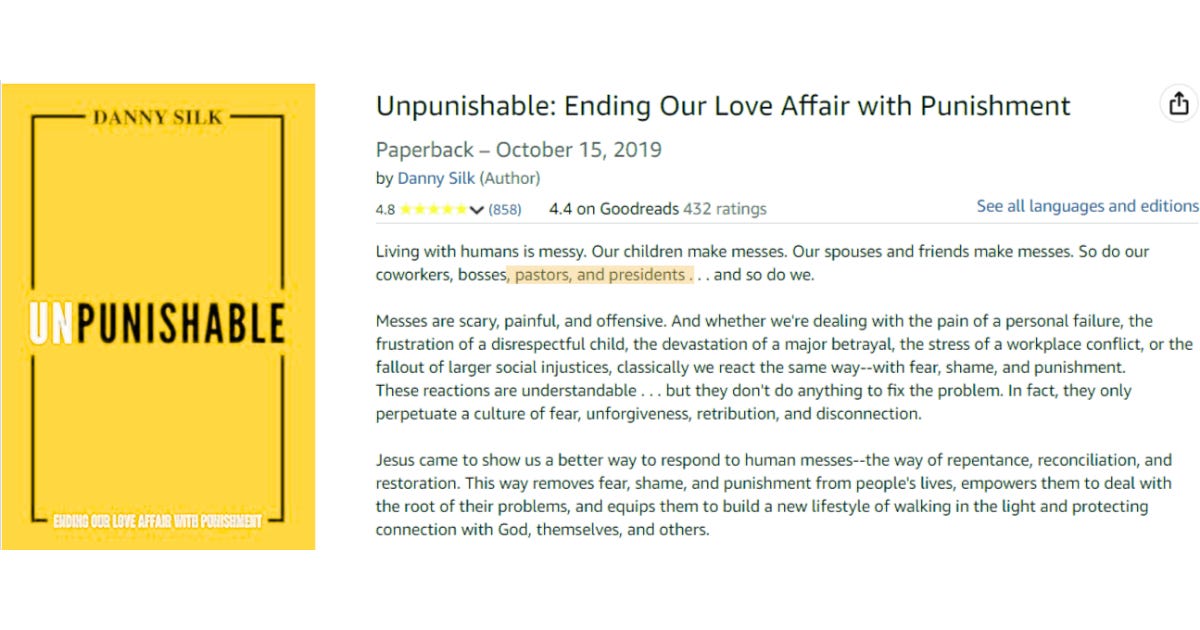
Its central argument is that ministers who abuse their positions of authority should be restored, not punished. Not held accountable. Not removed.
To permanently remove them is itself an act of punishment. To hold them out is to operate in the fallen paradigm. The kingdom response, always and without exception, is restoration.
He used two case studies to prove it.
One of them was a frequent speaker at Bethel, Jonathan Welton.
The Test Case
Jonathan Welton ran an online ministry school with students across the world.
He was also a diagnosed clinical covert narcissist and sociopath, rated by the psychologist who evaluated him as the worst case she had seen in thirty years of practice.

Over the course of a decade, Welton built a system.
He recruited young women, often from vulnerable backgrounds, often internationally, often by offering scholarships and staff positions and prophetic declarations about their destiny. He studied them. He used personality assessments and carefully constructed questionnaires to map their fears, their histories, their needs. He created secret groups bound by confidentiality.
He positioned himself as their spiritual father. He normalized inappropriate physical contact through theology about affection in the kingdom. And he moved, slowly and methodically, toward sexual encounters.
He did this across multiple women, across multiple years, across multiple restoration processes where he cried, declared transformation, found a new magic cure, and repeated the pattern.
When it finally collapsed, Danny Silk was called in to lead the accountability process.
While leading that process, Silk wrote Unpunishable.
Welton’s restoration was the centerpiece case study.
The psychologists on the accountability board said Welton was not better. The pastors who had worked with him for years said he was not better. The victims said they had never been contacted, never been heard, never been apologized to. The board members said Silk had a direct conflict of interest. His book needed a good ending.
Silk dissolved the board.
Dismissed the psychologists.
And declared Welton restored.
Then sold the book worldwide.
What Predators Learn
Jonathan Welton did not stumble into his methods.
He studied his targets. He identified the personality types most likely to comply. He built frameworks that made resistance feel like spiritual failure. He created social structures where his victims could not compare notes. He surrounded himself with defenders whose loyalty to him had become indistinguishable from their faith.
When someone finally confronted him, he cried.
When the tears did not work, he threatened.
When threats did not work, he sent anonymous emails asking witnesses to destroy evidence. When that was exposed, he cried again.
Every step was a tool. Every tool was deployed against someone who trusted him because the institution said he was safe.
This is grooming.
It is not unique to ministry. It is a transferable skill set. And it scales.
Jeffrey Epstein built an island. He recruited vulnerable young women through a network of gatekeepers who each had their own reasons to stay loyal and their own exposure to protect.
He surrounded himself with the powerful, made them complicit, and turned complicity into a leash. Nobody blew the whistle for decades because the cost of blowing the whistle was too high for everyone in the room.
Donald Trump spent forty years in business, entertainment, and politics doing a version of the same thing at a different scale. The Access Hollywood tape did not end his career. Two impeachments did not end his career. Four criminal indictments did not end his career. Thirty-four felony convictions did not end his career.
Because by the time those things happened, the grooming was complete.
Not of individuals. Of a movement.
How You Groom a Movement
The mechanics of grooming do not change when the target is a constituency rather than a person.
You find people who are already vulnerable. People who feel unseen, threatened, displaced. People who have been told that the culture is at war with everything they love and that they are losing. You offer them identity. Belonging. An enemy to focus on. A leader who sees them, names them, fights for them.
You make loyalty the price of membership and doubt the marker of betrayal.
You create a closed information environment where outside voices are not news but attack. Where the institutions that would normally provide accountability, courts, press, elections, oversight bodies, are reframed as instruments of the enemy.
You make exit catastrophic.
Not just socially. Spiritually. If the leader is anointed by God, then abandoning the leader is abandoning God. If the leader is chosen by God, then opposing the leader is opposing the purposes of history. If the punishment paradigm is the mark of the fallen nature, then demanding consequences for the leader is proof that you are operating from the serpent’s government.
The theology and the politics run on the same track.
Bethel built the track.
Redding to the Oval Office
Bethel Church in Redding, California is not a fringe institution.
It is the most influential charismatic church in the world. Its School of Supernatural Ministry enrolls thousands of students annually from across the globe. Its worship music fills evangelical churches on every continent. Its theology shapes how millions of Christians understand the prophetic, healing, and the nature of spiritual authority.
And it is deeply, structurally, unapologetically embedded in the MAGA movement.
Lance Wallnau, who popularized the Seven Mountains Mandate and called Trump a modern Cyrus, moves freely in Bethel’s orbit.
Kris Vallotton, Bethel’s senior associate leader, has been one of the most visible charismatic voices in the Trump coalition. The network of apostles and prophets who have laid hands on Trump, declared him anointed, and told their congregations that his political fortunes are spiritual warfare, that network has Bethel’s fingerprints on it at every level.
This is not background. This is infrastructure.
And the infrastructure runs on Silk’s teachings.
If punishment is not part of the kingdom, then the thirty-four felony convictions are persecution, not justice. If restoration is always the kingdom response, then the demand for accountability is always the fallen response. If the anointed leader cannot be judged by conventional moral standards because God works through imperfect vessels, then every accusation is an attack on God’s purposes.
The Welton victims could not get justice because the theology said justice was punishment and punishment was sin.
The American electorate could not hold Trump accountable because the theology said accountability was punishment and punishment was ungodly.
The mechanism is identical. The scale is different.
The Fawn Response
There is a psychological term for what happens to people who are trapped inside a predatory system they cannot safely exit.
Fawning.
It is the fourth trauma response alongside fight, flight, and freeze. When fighting is too dangerous and escape is impossible, the nervous system learns to appease. To perform loyalty. To become the defender of the person causing the harm.
Lindsay Wallace was Welton’s chief of operations for years. She knew things were wrong. She had experienced things herself. And for years she told the women coming to her with their stories that they were overreacting. That Jonathan was dealing with it. That the ministry was too important to jeopardize.
She was not lying. She was fawning. She had been inside the system long enough that defending it had become survival.
Watch the Republican members of Congress who privately called Trump a disaster in 2016 and now compete to be photographed with him. Watch the evangelical leaders who wrote worried letters about his character before the election and now declare him God’s instrument. Watch the donors and advisors and cabinet members who know what they know and say what they say anyway.
They are not all cynics. Some of them are fawning.
They got in deep enough that the cost of honesty became too high. Exposure of the leader means exposure of themselves. The system that protected him now protects them only as long as they keep protecting him.
Welton made Lindsay Wallace a defender before she understood what she was defending.
The movement did the same thing to millions of people.
What Silk’s Book Actually Does
Unpunishable is not a naive book. It is a sophisticated one.
It takes a genuine insight about grace, the insight that shame-based religion damages people and that restoration matters, and extends it past the point where it protects anyone.
In Silk’s framework, the only person whose journey matters is the person who fell. The victims are largely invisible.
The community that needs protection from the predator is not the primary concern. The restoration of the fallen leader is the kingdom goal, and anything that interrupts that restoration is the punishment paradigm speaking.
This is not an accident of bad writing. It is the logical conclusion of a belief that removes consequences entirely.
When that teaching reaches a diagnosed sociopath, the sociopath does not encounter grace.
He encounters a system with no immune response.
He learns the vocabulary of repentance without the substance. He learns that crying produces results. He learns that declaring transformation resets the clock. He learns that the people responsible for accountability have been pre-disarmed.
Welton learned it in a ministry school.
Trump learned it from the evangelical leaders who surround him.
The book sold the framework to the churches that sent the students, who became the pastors, who told their congregations that the punishment paradigm was sin.
The Sacred Violated
There is something worth naming directly.
Jonathan Welton violated things that were supposed to be inviolable. The trust placed in a spiritual father. The safety of the confessional. The sanctity of someone who came to him to grow in faith and left with their nervous system in pieces, their finances destroyed, their sense of reality dismantled.
These were not minor violations. They were the violation of the most sacred covenant available in the religious community. The shepherd and the sheep.
Trump violated things that were supposed to be inviolable. The peaceful transfer of power. The independence of the judiciary. The principle that no one is above the law. The sacred covenant of democratic governance that generations of Americans fought and died to protect.
Both men found that the sacred was not protected by its sanctity. It was only protected by the willingness of people around it to enforce its boundaries.
And both men found themselves surrounded by people who had been pre-conditioned to believe that enforcement is wrong.
The institutions fell not because they were weak. They fell because the people who should have defended them had been taught that defense was punishment and punishment was not of God.
What Grace Actually Is
This piece is not an argument against grace.
Grace is the only thing that makes any of this bearable to write. Grace is what let the women who were destroyed by Welton find language for what happened to them and use it to protect the next woman. Grace is what allows a country to reckon with what it has allowed and still believe something better is possible.
But grace without truth is not grace.
It is cover.
The father in the prodigal son story does not pretend the son did not waste his inheritance. He does not tell the older brother the younger son’s choices had no consequences. He does not hand the younger son the keys to the estate on the morning he returns and declare him restored to full leadership.
He runs to meet him. He throws a party. He declares him alive and found.
He does not put him back in charge of anything yet.
That distinction is the one Silk’s framework collapses. And the collapse has not been contained to a ministry school in California or an online school with no fixed address.
It has reached the highest office in the world.
The Room That Made It Possible
Danny Silk stood in front of thousands of students and told them punishment was not godly.
He was not wrong about grace. He was wrong about power.
Grace extended toward the genuinely broken is the most powerful force in human experience. Grace extended toward the predator who has learned to perform brokenness is not grace. It is a weapon handed to someone who already knows how to use it.
Jonathan Welton is still trying to return to ministry. His victims are still in therapy.
Danny Silk’s book is still in print.
Bethel’s network is still the theological backbone of the most powerful political movement in America.
And somewhere in a church right now, a pastor is telling his congregation that demanding accountability for the anointed is the punishment paradigm speaking.
That pastor learned it from a book.
The book learned it from a theology.
The theology learned it from a room in Redding where nobody asked the question that needed asking.
What happens when someone learns to use this?
We know the answer now.
We have always known the answer.
We just keep handing them the theology and acting surprised.
Thank you for this. Very informative. And awful. I have friends and relatives whose lives have been poisoned by this Redding group. It is deeply painful and toxic.
Thank you for this piece. I did not know much about Bethel or the theology from Silk’s book.
Why did Silk develop this theology? I understand that maintaining wealth, power, and status was behind the development of theological racism and hierarchy. I don’t understand why Silk developed a theology like this. What was his incentive or lens or blind spot? And why did the book sell so well? It’s frightening that a good teaching about grace could be so thoroughly warped.
I wonder if this theological error would have developed without the soil of penal substitutionary atonement.